
Search
Early childhood education and care (ECEC) is widely recognized for supporting children's development and school readiness; however, evidence from Western Australia remains limited.
This study examines whether nonstandard work schedules (NSWS) improve or hinder work-life balance (WLB) for parents and non-parents in dual-earner households.
There is an urgent need for scalable interventions to promote physical activity in early childhood. An early childhood education and care physical activity policy intervention with implementation support strategies (Play Active) has been proposed for scale-up in Australia.
Yalemzewod Assefa Gelaw PhD, MPH, BSc Honorary Research Associate Yalemzewod.Gelaw@thekids.org.au Honorary Research Associate Dr Yalemzewod Gelaw
Ensuring that Aboriginal and Torres Strait Islander children removed from their families by child protection services remain connected to their kin, Country and culture is a priority to begin to redress the intergenerational trauma and harm caused by colonisation. This article describes the views of staff working in three mainstream out-of-home care organisations, where children are cared for by non-Indigenous foster carers.
The objective of this study was to explore Australian children's engagement in physical activity and screen time while being cared for by their grandparents.
Many children do not accumulate sufficient physical activity for good health and development at early childhood education and care (ECEC). This study examined the association between ECEC organizational readiness and implementation fidelity of an ECEC-specific physical activity policy intervention.
Despite increasing urbanisation, little is known about skin health for urban-living Aboriginal children and young people (CYP, aged <18 years). This study aimed to investigate the primary care burden and clinical characteristics of skin conditions in this cohort.
Globally, Indigenous peoples have incurred significant harm due to colonisation of their lands. Dispossession of culture, language, family and land, and the historical, systematic removal of children in Australia (the ‘Stolen Generation’), has resulted in evident ongoing negative outcomes in the contemporary lives of Aboriginal and Torres Strait Islander people.
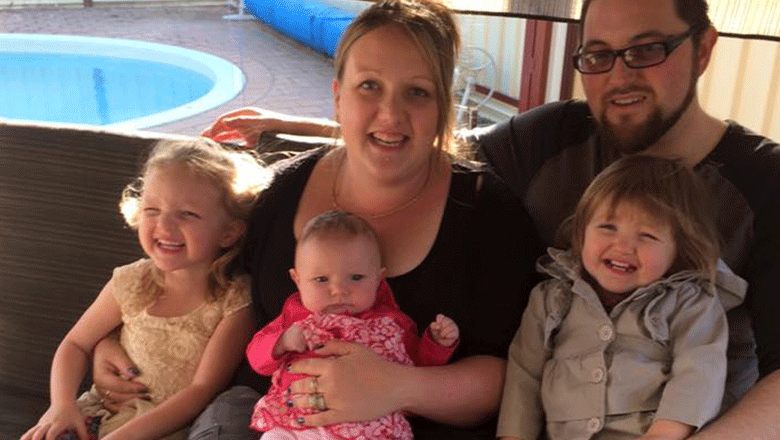
The Kids Research Institute Australia researchers are offering a free nutrition and lifestyle program for plus sized mums and their babies who live in the Joondalup area.