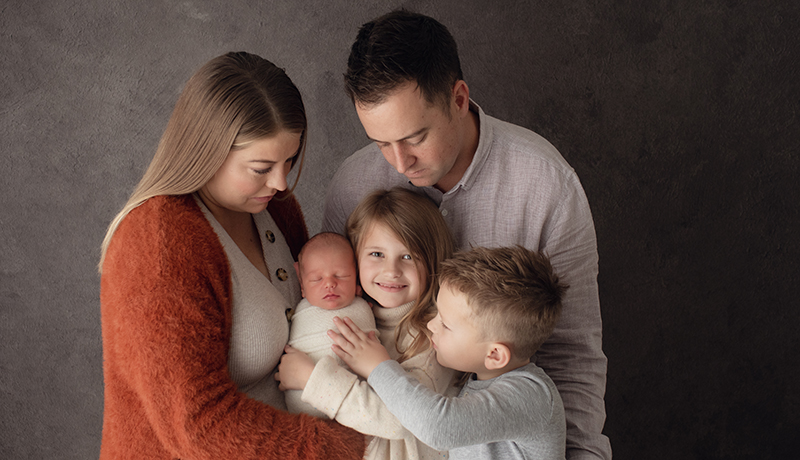
Lauren and Glenn Raphael with daughter Isla, who has autism, son Ashton, and baby Magnus.
Credit: Michelle Jones, Little Brown Rabbit Photography.
Video technology is helping autism researchers learn more about the earliest features of autism, and in turn is helping families gain access to better interventions.
Worry. Every parent does it, but for those who have children with disabilities, it can be all-consuming.
For Perth mother Lauren, autism – and the worry that goes with it – often consumes her thoughts. Her seven-year-old daughter Isla has autism spectrum disorder, a diagnosis she received at the age of four.
“‘What will she eat today?’, ‘Will she ever learn to read or ride a bike?’ – you worry if they will be able to live independently one day,” Lauren said. “You strive to remain positive and set them up to achieve but it doesn’t stop those thoughts creeping in.”
Now, with the arrival of their third child Magnus, Lauren and her husband are trying not to worry about the fact that Isla’s experience with autism means their newborn has a heightened chance of developing differently.
Research has shown children with a family history of autism are more likely to develop autism or other developmental disorders – with children who have a full sibling or biological parent with autism 20 per cent more likely.
This knowledge has spurred CliniKids, the first clinical branch of The Kids Research Institute Australia, to launch a world-first trial that uses video technology to help these babies improve their brain development from birth.
Professor Andrew Whitehouse, Director of CliniKids and The Kids Research Institute Australia Angela Wright Bennett Chair of Autism Research, said the Communicating and Understanding your Baby (CUB) Study was built on a previous study – AICES – that showed the benefits of video interventions on the development of infants.
“This trial is helping researchers get one step closer to improving how we provide support to children on the autism spectrum,” Professor Whitehouse said.