
The qualities siblings value
Young people valued kindness, empathy, social skills, health, creativity and self-awareness when describing their strengths and hopes for the future.
Read the study
The studies this project has conducted
Discover what we’re learning about life as a sibling of someone with a developmental disability.
Explore the findings
Select a topic to see what we have found.
National sibling survey
Our national survey explored sibling strengths, wellbeing, experiences and perspective.
Young people valued kindness, empathy, social skills, health, creativity and self-awareness when describing their strengths and hopes for the future.
Read the studyCompared with other siblings, survey participants whose sibling had a neurodevelopmental condition reported more anxiety and depression, and poorer sleep.
Read the studyHigh levels of mental health diagnoses and poor wellbeing persisted. Sleep difficulties helped predict poorer wellbeing at follow-up.
Read the studyResponses showed overall lower performance in skills such as working memory, attention and flexible thinking.
Read the studyCompared with a control group, siblings reported higher rates of self-harm, suicidal thoughts and suicide attempts. These findings highlight important support needs.
Read the studySiblings more often reported a history of traumatic brain injury than the control group. This was associated with psychiatric diagnoses and autistic or ADHD traits.
Read the study
Rural study
93 siblings aged 16–30 in regional and remote Australia described unmet needs and self-reliance. They valued online support, shared activities, being acknowledged as individuals, and supported as a sibling.
Linked data
Linkage of disability and family data in WA showed that children with neurodevelopmental conditions are more likely to have siblings in their family, and larger family sizes. Birth order varies, and family sizes have generally reduced over time.
Read the studyOur review found that linking population records can help understand a wide range of sibling health outcomes and bring more attention to their support needs.
Read the study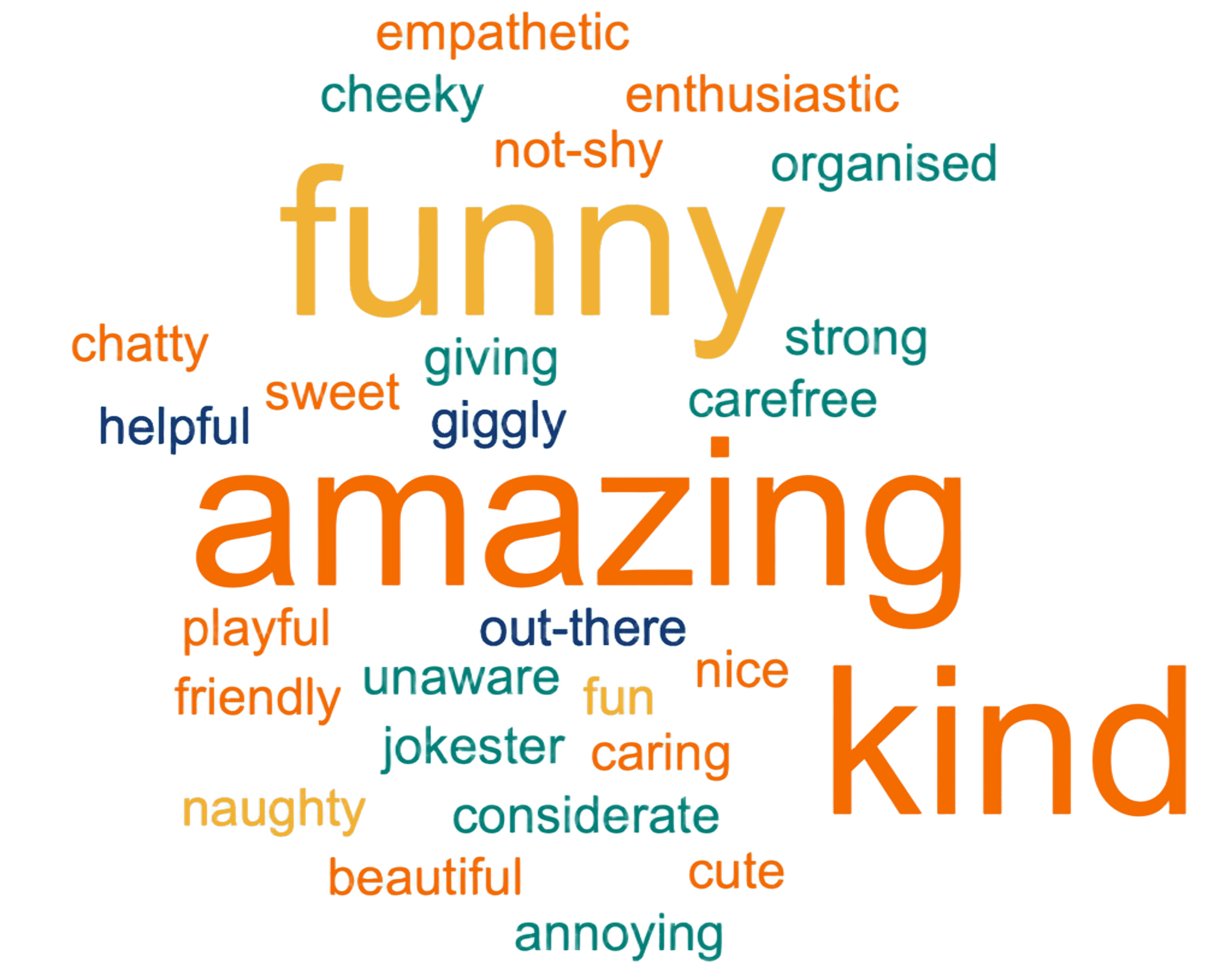
Sibling voices
We asked young siblings to describe their brother or sister with Down syndrome using three words.
In their own words
“… siblings have pretty similar experiences and it's important to celebrate and recognise how awesome it is to have a disabled sibling when the world has a tendency to look at disability with pity”
Down Syndrome WA Sibling Camp participant, aged 16
More sibling voices
Sibling connections
“Connecting with other siblings is really valuable…”
Down Syndrome WA Sibling Camp participant, aged 16
“Connecting with others is already valuable, but connecting with others similar to you helps recognise yourself in others and vice versa... I also like making friends”
Participant, aged 16
“Mentorship, new friendship connections, learning from each other...”
Participant, aged 12
Sibling voices
We asked young siblings to use three words to describe their relationship with their brother or sister with Down syndrome.


Moments from our sibling camp gallery. Select a photo to view it in full.
Parent study
Parents of children and young adults with Down syndrome or Rett syndrome described siblings’ positive qualities, close relationships and optimistic outlooks. Some parents also spoke of having less time for siblings, and challenges planning family holidays.
Read the studyLiterature reviews
Our literature reviews bring together what is known about sibling wellbeing and support.
Our review found higher risks of mental health conditions, especially anxiety and depression, and poorer quality of life. It also found evidence of resilience and personal growth.
Read the studySibling support improves self-esteem, emotional wellbeing and sibling relationships. More focus on individualised supports is needed.
Read the studyPublications
Antonio S, Jamieson K, Dorozenko KP, Glasson EJ & Maxwell-Smith C (2026, in press). Wellbeing and support preferences of siblings of individuals with a neurodevelopmental condition in regional and remote Australia: A mixed methods investigation. Disability and Rehabilitation.
Read the paperAntonio S, Jamieson K, Dorozenko KP, Glasson EJ & Maxwell-Smith C (2026). “The Absolute Dearth of Resources”: Challenges and Unmet Support Needs for Emerging Adult Siblings of Individuals with Neurodevelopmental Conditions in Regional and Remote Australia. Research in Developmental Disabilities, 175:105331.
Read the paperWolff B, Glasson EJ & Pestell CF (2026). Siblings of individuals with neurodevelopmental conditions: perspectives on risk, resiliency and future research directions. Child & Family Social Work, 31(1):597-606.
Read the paperGray, C., Leonard, H., Cooper, M. N., Rai, D. and Glasson, E. J. (2025) “The application of population data linkage to capture sibling health outcomes among children and young adults with neurodevelopmental conditions. A scoping review”, International Journal of Population Data Science, 10(1). doi: 10.23889/ijpds.v10i1.2413.
Read the paperGray, C, Leonard, H, Wong, K, Reed, S, Schmidt, K, Skoss, R, Li, J, Salt, A, Bourke, J, and Glasson, EJ (2024). Down syndrome or Rett syndrome in the family: Parental reflections on sibling experience. J Intellect Dev Disabil, 49(1): p. 11-24.
Read the paperWolff, B, Glasson, EJ, and Pestell, CF (2024). "Broken fragments or a breathtaking mosaic": A mixed methods study of self-reported attributes and aspirations of siblings of individuals with and without neurodevelopmental conditions. J Res Adolesc, 34(3): p. 1005-1017.
Read the paperWolff, B, Glasson, EJ, Babikian, T, and Pestell, CF (2024). Self-Reported Traumatic Brain Injury and Its Biopsychosocial Risk Factors in Siblings of Individuals with Neurodevelopmental Conditions. Dev Neuropsychol, 49(6): p. 225-242.
Read the paperWolff, B, Franco, VR, Roberts, R, Skoss, R, Magiati, I, and Glasson, EJ (2024). Stability and change in self-reported risk and resilience factors associated with mental health of siblings of individuals with and without neurodevelopmental conditions over 15 months. Advances in Mental Health, 22(3): p. 653–681.
Read the paperWolff, B, Franco, VR, Magiati, I, Cooper, MN, Roberts, R, Skoss, R, and Glasson, EJ (2023). Individual-Level Risk and Resilience Factors Associated with Mental Health in Siblings of Individuals with Neurodevelopmental Conditions: A Network Analysis. Dev Neuropsychol, 48(3): p. 112-134.
Read the paperWolff, B, Magiati, I, Roberts, R, Skoss, R, and Glasson, EJ (2023). Psychosocial Interventions and Support Groups for Siblings of Individuals with Neurodevelopmental Conditions: A Mixed Methods Systematic Review of Sibling Self-reported Mental Health and Wellbeing Outcomes. Clin Child Fam Psychol Rev, 26(1): p. 143-189.
Read the paperWolff, B, Franco, VR, Magiati, I, Pestell, CF, and Glasson, EJ (2023). Psychosocial and neurocognitive correlates of suicidal thoughts and behaviours amongst siblings of persons with and without neurodevelopmental conditions. Res Dev Disabil, 139: p. 104566.
Read the paperWolff, B, Franco, VR, Magiati, I, Pestell, CF, and Glasson, EJ (2023). Neurocognitive and self-reported psychosocial and behavioral functioning in siblings of individuals with neurodevelopmental conditions: a study using remote self-administered testing. J Clin Exp Neuropsychol, 45(5): p. 513-536.
Read the paperWolff, B, Magiati, I, Roberts, R, Pellicano, E, and Glasson, EJ (2022). Risk and resilience factors impacting the mental health and wellbeing of siblings of individuals with neurodevelopmental conditions: A mixed methods systematic review. Clin Psychol Rev, 98: p. 102217.
Read the paper